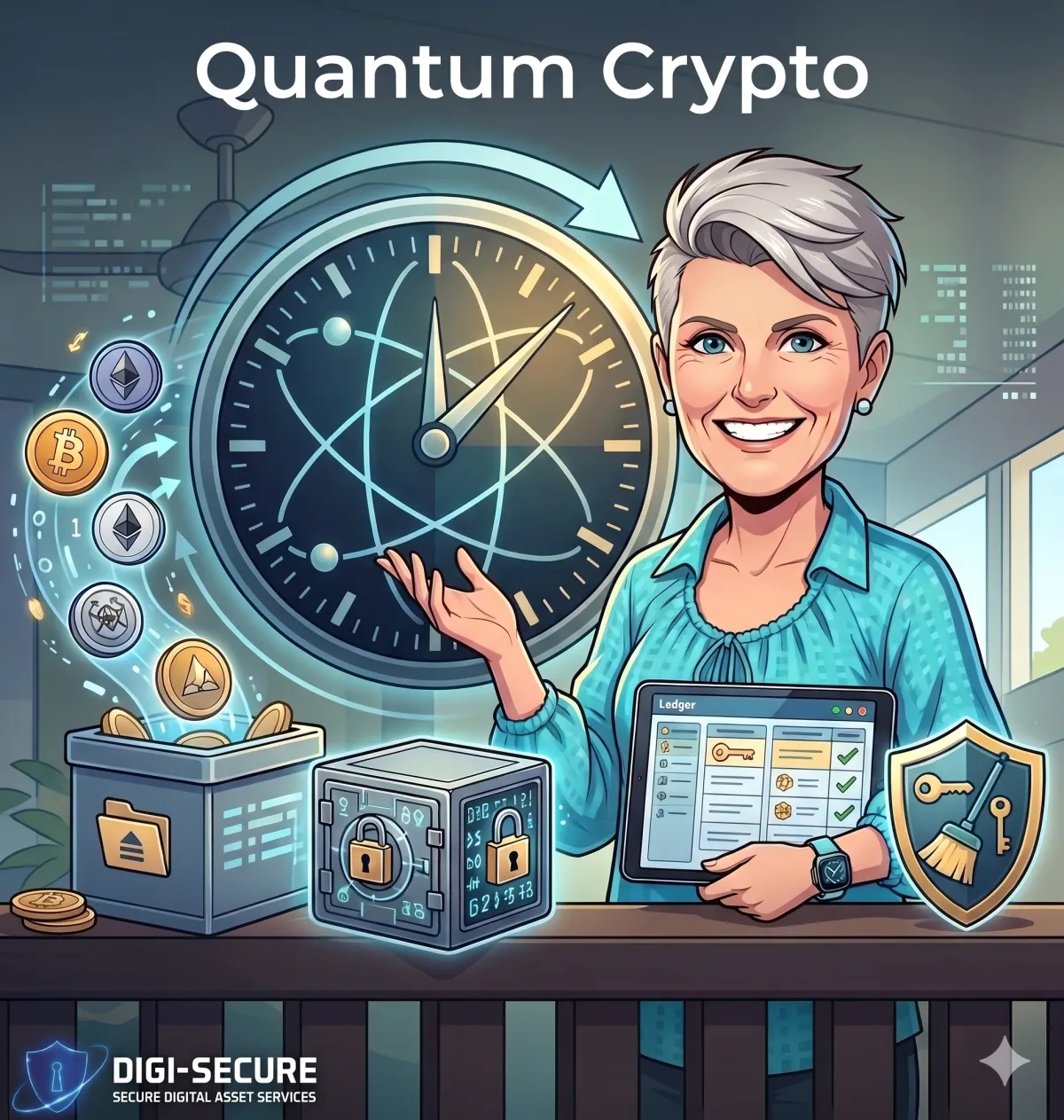
The Quantum Clock Just Moved Forward. Here’s What It Actually Means for Crypto
If you hold cryptocurrency and haven’t yet heard about Google Quantum AI’s paper from late March, you’re not alone. Most of the people I’ve spoken with in the last fortnight haven’t either. The ones who have, almost all of them, have either dismissed it as a 2035 problem or pushed it aside because they assumed it was the kind of news that always sorts itself out before it matters.
I’d like to walk you through why I don’t think either of those reactions is quite right.
This isn’t a piece designed to alarm you. I make my own income from crypto, so the last thing I want is for the people I work with to make panicked decisions because of a research paper. What I do want is for you to have the information, in plain language, so the decisions you do make are the ones you’d be comfortable with in five years’ time.
What Google Actually Said
On the 31st of March, Google Quantum AI published a paper aimed specifically at the cryptocurrency community. The substance is this. The cryptography that signs every transaction in your wallet, called elliptic curve cryptography, can now be broken with roughly twenty times less quantum computing power than the industry was operating on a year ago. Not a small refinement. A meaningful jump.
Six days before that paper went out, Google had quietly brought forward its own internal post-quantum migration deadline to 2029. Six years sooner than what they were publicly committed to before.
When the company building some of the most advanced quantum hardware on the planet shortens its own timeline by six years, that’s a signal worth pausing on.
Why This Doesn’t Mean What You Might Think
A few things this paper isn’t.
It isn’t an announcement that Bitcoin is about to be cracked. It isn’t a date. Nobody, including Google, can tell you the exact year a quantum computer powerful enough to break elliptic curve cryptography will exist. Anyone giving you a confident timeline is either guessing or selling you something.
It also isn’t an instruction to move funds in the next 48 hours. If anyone is using the word “quantum” to push you into urgent action, that’s the loudest signal to walk the other way. Panic is the most expensive emotion in this asset class.
The Bit People Aren’t Talking About
There is one part of this that doesn’t make headlines but is, in my view, the more uncomfortable conversation to have.
It’s a technique called harvest now, decrypt later. Someone copies your public blockchain data today, stores it cheaply, and waits. They don’t need a working quantum computer right now. They only need to believe one will eventually exist. At the moment, that belief is very cheap.
Which means every reused address, and every public key sitting exposed on-chain, isn’t a problem for today. It’s a deferred problem. You’re effectively leaking information to five years from now.
The window isn’t when quantum arrives. The window is right now, while the data is still being collected.
What’s Actually Worth Doing
The work is not about chasing a quantum-proof product. Most of what’s already labelled “post-quantum ready” hasn’t been tested against any working quantum system, because no working system exists at scale yet. Buying your way out of this isn’t a real option in 2026.
What is real is housekeeping. Three things in particular.
First, knowing where every asset you hold actually lives. If I asked you to write down every wallet you own, the keys associated with each one, and how you’d access them in an emergency, could you do that in ten minutes? If not, that’s the first piece of work, and it has nothing to do with quantum.
Second, reducing your on-chain exposure. Most modern wallets handle address rotation reasonably well. Worth checking that yours is set up to do so.
Third, asking your providers what their post-quantum migration plan actually looks like. Not whether they’re “aware” of quantum. What their plan is. If they don’t have one, that tells you something. If they do, that tells you something too.
What I Keep Coming Back To
The threats keep changing names. Quantum is the conversation right now. Twelve months ago it was AI-driven phishing. Twelve months before that, it was exchange collapses. The names rotate. The work doesn’t.
Know what you hold. Limit your exposure. Choose providers who can answer specific questions about the next five years, not vague ones about the past five.
That work was sensible in 2020. It’s sensible in 2026. It will be sensible in 2030. Quantum is just the latest reason to actually do it.
If You’d Like to Go Deeper
I’m hosting a free 30-minute session on this on Tuesday, 12th May at 6:30pm QLD time. Register here:
https://us02web.zoom.us/meeting/register/UPVnKN20RMi7SiulFlM4Dw#/registration
For a one-on-one conversation about your own setup:

